

Hoi Tong Face Powder
Contributed by Gigi Pun
Produced by Sam Yong Cosmetic Co., this face powder was originally used by Chinese women during the practice of threading fine facial hair. It is now used as a polish for jewelry. This object represents the old Hong Kong, when it was a thriving trading port and manufacturing city. For Gigi, this Hoi Tong face powder “delivers a nostalgic feeling.”
Jenny’s Vase
Contributed by Judy Rogers
This vase lived on a very large bookshelf in Jenny Hoffman’s home. She was born in the early 1900s. Judy read from this library as a child. Jenny was a mixed-race person with blond hair and gray-blue eyes. She refused to identify as “white passing.” She was an educator and a mother of seven. Her passion for children led her to adopt her seventh child. Growing up, Judy became her unofficial “eighth child.” Judy was drawn to Jenny’s story. Her home was a safe haven for Judy, a transnational adoptee from Korea living in rural Virginia. Judy learned about the world through Jenny’s books and objects. For Judy, “Jenny’s vase became a symbol of beauty and culture.”
Ivory Black Woman Figure
Contributed by Soraya Jean-Louis
This Ivory Black Woman Figure from Ayiti belonged to Soraya’s parents and was gifted to her father by either his mother or his aunt. It adorned the mantels of their family homes while she was growing up in Harlem and Brooklyn, and Soraya always loved it. Her mother gifted it to her when she moved from Brooklyn to New Orleans.
Ironing — The Way Through Life
Contributed by Kathleen Benjamin
Initially a means of generating income for Kathleen’s grandmother, the iron has become a reminder of how domestic activities can double as an expression of beauty and the excellence of people. Kathleen herself worked in the domestic sphere as a private chef, a career path that eventually paved the way to a successful business. This iron is a paint brush: it can be used practically, to remove wrinkles or as a doorstop; it can also be used to create abundance.
Prairie-Mountain Wildflowers Southern Pacific Lines Coffee Cup
Contributed by Wendy Gaudin
Eleanor Marietta Gaudin-Rivera rode the Sunset Limited line of the Southern Pacific Railroad from Los Angeles to New Orleans in approximately 1942. She traveled with her mother, Marietta Roussel Burns, to visit family in New Orleans and in Vacherie, Louisiana. Eleanor’s father, Augustus Lawrence Burns, was a porter for the Pullman Company–also known as a Pullman Porter–at the time. Marietta Roussel Burns kept the coffee mug as a memento of their travels. At one time, Eleanor also had a saucer and a blanket from the Pullman sleeping car, but those items have been lost or misplaced.
Chamoy de Navolato
Contributed by Isaac Trejo
Isaac’s family is from Culiacan, Sinaloa, and they boast the best chamoy, el chamoy de Navolato, which is produced in a small neighboring town. When his family returns from Culiacan, they gift him a big bottle of chamoy. Objects like these, that are imbued with the spirit of a place, instill a sense of pride in his ancestral roots, while also serving as a reminder that to identify as Mexican while growing up in the United States is to feel the awkward position of having one foot on either side of the fence.
Swipe from left to right over the object to explore. Tap to learn more.
Hover to explore the object. Click to learn more.
About the Project
subterranean convergence, by artist LaRissa Rogers, is a sculptural installation and score for performance at Los Angeles State Historic Park. Rogers uses the train as a vessel and a metaphor to trace the geographies of the railroad between the American South and West, investigating how liberation has been conceptualized—and where it might still be. The artist assumes the roles of caretaker, archivist, and laborer to build a simulated railroad complete with tabby-cast objects reproduced from archives and individuals. This project explores collective memory by archiving the movements of people and goods across generations and geographies.
The Sunset Limited rail route has connected New Orleans and Los Angeles since 1894, representing possibilities for Black Southerners and new immigrants to resettle in the West. Some came through the Southern Pacific River Station, which is now the site of this installation. The repetition of routing and rooting within and across generations has become a grammar for Black life, one that Rogers contends with here. Over 50 community members and institutions along the historic route were invited to contribute objects of personal or historical significance, some of which were reproduced. This invitation questions what it means to be at home in America and whether liberation lies in holding in tension all of the complex histories of rooting and uprooting, voluntary and forced migration, and hope and mourning. For Rogers, these objects can unearth what it means to endure, to reposition what it means to be carried, and to journey through the passage of time toward a new destination.
The steel form of the railroad traces the route across two dirt medians, and its interior wooden tracks echo the chinoiserie designs found in architecture in the American South and in Los Angeles’s Chinatown. Chinoiserie, a decorative style that appropriates East Asian aesthetics, was popularized in Greek Revival architecture by Enlightenment-era thinkers to visually encode the founding values of the nation through governmental and domestic buildings. In LA’s New Chinatown, chinoiserie appears in the exoticized, Hollywood-inspired version of Shanghai, reimagined by the immigrant community themselves as a gesture of belonging—revealing how the repetition of an aesthetic can take on new meanings.
Anchored within the tracks are cast objects constructed with tabby, an ancient building material of lime, sand, and oyster shells originating in northern coastal Africa and used by enslaved peoples in the South. Through the process of reproduction—scanning, 3D printing, mold making, and casting—the objects adapt to and join the archive’s visual language of tabby while retaining their core sentimental essence.
Through a collaboration with artist Michelle Sui, a visual score for the performance invites visitors to engage with the installation. Accompanying the installation will be a website containing the score, an ArcGIS map of all contributed objects and their information, and a curriculum coproduced with scholar Angel Adams Parham. This project offers strategies for examining the tensions between the fantasy of flight and groundedness, considered here as a communal memorial.
CREDITS
subterranean convergence, by LaRissa Rogers, was commissioned by Clockshop and curated by Cat Yang, Director of Artist Projects, and Isabel Yi Jimenez, Artist Projects Manager. Clockshop’s projects at Los Angeles State Historic Park are supported through our long-standing partnership with California State Parks.
The production of this work was generously supported by the Hearthland Foundation, the Mike Kelley Foundation for the Arts, the National Endowment for the Arts, Anonymous Was A Woman, University of Virginia Karsh Institute and Department of Art, Accelerated Resilience Los Angeles, Betsy Greenberg, and Clockshop’s generous community of supporters. subterranean convergence is supported by the Digital Technology for Democracy Lab, a project funded by UVA’s Grand Challenges Research Funds. A special thank you to Angel Adams Parham, Michelle Sui, Jheanelle Brown, Sharon Chohi Kim,Victoria Valdes, Carolyne and Bill Edwards, Foothill Steelworks, Wendy Gaudin, Santa Monica History Museum, Antenna, Ashé Cultural Arts Center, Steve Campos, Charisma Design Studio Inc., Ana's Iron Supply, Jacqueline, Benedicto, Nicole Jaffe, Maegan Leslie Torres, Naree Kae, and all open call contributors.
About the Artist
LaRissa Rogers (b. 1996) is a multidisciplinary artist whose work investigates how personal and shared memory and history impact the perpetual evolution of cultural identity formation and placemaking. She has exhibited at Documenta 15 (Germany); Weserburg Museum (Germany); Lilley Museum (NV); the Wattis Institute of Contemporary Art (CA); the California Museum of Photography (CA); the Virginia Museum of Contemporary Art (VA); Los Angeles Contemporary Exhibitions (CA); California State University, Fullerton; The Massachusetts College of Liberal Arts (MA); Torrance Art Museum (CA); and the Fuller Craft Museum (MA). She received the Visual Arts fellowship at the Virginia Museum of Fine Arts (2022) and the Fine Arts Work Center Fellowship (2023–2024). Rogers has also held residencies at the Bemis Center of Contemporary Art (2022), the Skowhegan School of Painting and Sculpture (2024), and MASS MoCA (2025). Rogers is a tenure-track assistant professor and sculpture area head at the University of Virginia. She is currently represented by Super Dakota.
About Clockshop
Clockshop is a nonprofit organization based in the Elysian Valley of Los Angeles that works to deepen the connection between artists, communities, and public lands to co-create a culture of care. We do this by building long-term collaborative relationships with artists, like-minded partners, our neighbors, and public lands throughout our region, such as the Bowtie along the LA River and LA State Historic Park.

Collaborators
Angel Adams Parham
Angel Adams Parham engages in research on the historical and comparative-historical sociology of race. She is the author of American Routes: Racial Palimpsests and the Transformation of Race (Oxford, 2017), co-winner of the Social Science History Association’s Allan Sharlin Memorial Book Award (2018); co-winner of the American Sociological Association’s Barrington Moore Book Award (2018); and an Honorable Mention recipient of the ASA Thomas & Znaniecki Best Book Award (2018). Her forthcoming book, Reckoning and Reconciliation: On Race, Place, and Memory in American Life, compares the social histories of three key sites in New Orleans over a 300-year period. Parham has been a member of the School of Social Science at the Institute for Advanced Study in Princeton, as well as the recipient of a Fulbright grant. She received her bachelor’s degree from Yale University and completed her doctoral work at the University of Wisconsin-Madison.
angelparham.com
Jheanelle Brown
Jheanelle Brown is an educator, arts administrator, writer, and curator. Brown currently teaches at California Institute of Arts, where in addition to teaching film studies, she serves as curator for the Film at REDCAT program. Brown serves as a programmer for Los Angeles Filmforum, where she recently served as Project Director for Experimentations: Imag(in)ing Knowledge in Film for the Getty’s PST:Art initiative. At this moment, she is dreaming about cosmic marronage whilst trying to remember her terrestrial obligations.
Sharon Chohi Kim
Sharon Chohi Kim is a Los Angeles–based performing artist and composer creating site-responsive interdisciplinary works through voice, movement and installation. Exploring collectivity, ecological interdependence, and human and nonhuman communication, her work has been presented by MOCA, REDCAT, LA Phil Insight, and The Ford, Long Beach Opera, Human Resources LA, LAMAG, Wende Museum, among others. She is a 2026 Creative Capital Award recipient.
sharonchohikim.com
Michelle Sui
Michelle Sui is an artist, performer, composer, choreographer, and director whose work spans across film, opera, dance, theatre, installation, oral histories and new technologies. Their work has shown at Museum of Contemporary Art, LA Music Center, Rubin Museum of Art, La MaMa Umbria International (IT), Rote Fabrik (CH), Cité internationale des arts (FR) and received support from Foundation for Contemporary Arts, The Mellon Foundation, California Arts Council, Sundance Institute, Bang on a Can, New York Foundation for the Arts, Rauschenberg Foundation, and Poets and Writers. Sui is a member of the 2024–2025 Public Artists in Development (PAiD) Artist Council, and in 2024, they were commissioned by Los Angeles County to create a public artwork in the historic Pico House. Sui is the writer and director of three films on Los Angeles and a feature film with live score on Anna May Wong is forthcoming in 2027.
michellesui.com
Website Project Team
Jacqueline Benedicto, Project Manager
Nicole Jaffe, Web Developer
Naree Kae, Graphic Designer
Maegan Leslie Torres, GIS Specialist/Cartographer
Support







Contributors
Open Call
Antenna, Ashé Cultural Arts Center, Kayla Andrus, Se Young Au, Malik Baloney, Kathleen Benjamin, Aidan Marie Maeve Bigard, Brandon-Marie Bigard, E. Chris Brady, CJ Calica, Nadia Castro, Quinn Research Center, Kyle Chen, Jahziel Chu, Gina Clyne, Michael Duckworth, Bill Edwards, Carolyne Edwards, Ella Fitzgerald, Wendy Gaudin, Jennyffer Giraldo, Mark Gozonsky, Mikayla Harrell, Omar Ruiz Hernandez, Asuka Hisa, Julie Holman, Rahsaana Ison, Soraya Jean-Louis, Daria Jiles, Jessica Johnson, Roberto Torres Mata, Ebonie Mathews, LaShaunda Pickett-René, Gigi Pun, Monica Mejia R., Lynn Robb, Judy Rogers, Santa Monica History Museum, Sharita Sims, Nell Slaughter, Alexius Diana Smith, Daniel Soto, James Brooks, Sr., Avery Temple, Fred Thompson, Isaac Trejo, Chastidy Vasconez, Keith Carr Walsh, Michelle Salinas Wamungu, Caitlin Ezell Waugh, Nathaniel Whitfield, Cindy J. Xie, Norge Yip
Public Casting Workshop
Katie Ryan, Ayush Garg, Sharon Leung, Thomas Miller, Lily Laugharn, James Obed, Thomas Obed, Ayasha Guerin, Joy Singh, Sabrina Fielden, Evelyn Serrano, Hannah Tsai Kim, Chase Melton, Soham Patel, April Banks
Summer Youth Fellowship x Casting Workshop
Allisson Hernandez-Lozano, Anthony Rivera, Ashley Cos-Sica, Elias Muratalla, Erika Celedon Miramon, Frank Casillas, Giovanni Ozelotzin-Hernandez, Hayley Rodriguez, Juliane Prudencio, Maya Dailo, Nathan Moyes, Oscar Umana, Perla De La Rosa Diaz, Sofia Zarate Sotelo
3D-Scanning and Storytelling Workshops
Tabby Casting Workshops
Sunset Route Timeline
1566
The oldest known appearance of tabby in the Americas is used in the construction of Fort San Antón de Carlos in Mound Key, Florida. Tabby, a form of concrete in which oyster shells are used as aggregate, originated in Northern Africa and was transported to Florida by Spaniards. It was also used by enslaved people in coastal cities to build plantation outbuildings and slave quarters.
Early 1600s–1700s
Chinese porcelain and export wares are introduced to Europe and its North American colonies through Portuguese merchants, and later via the Dutch East India Company’s monopoly of East Indian trade routes, and become fashionable and affordable among the middle and upper classes.1
1 “Archaeology CTL Chinese Porcelain | South Carolina Parks Official Site.” 2023. Southcarolinaparks.Com. 2023. https://southcarolinaparks.com/artifact-corner/ctl-chinese-porcelain.
1850s
“The entire southern railroad network that was built during the slavery era was built almost exclusively by slaves. Some of the railroads owned slaves, other railroads hired or rented slaves from slave owners. […] Both free blacks, as well as white workers [worked alongside enslaved Black people].”2
2 Cavanaugh, Maureen. 2010. “The African-American Railroad Experience.” KPBS Public Media. https://www.kpbs.org/news/living/2010/03/23/african-american-railroad-experience.
1861–1865
The American Civil War, a conflict between the United States and 11 states that seceded to form the Confederate States of America, is active, the culmination of decades of regional tension between advocates and opponents of slavery.
1865–1877
During the Reconstruction era, the period in history immediately following the Civil War, the United States sought to reintegrate former Confederate states into the Union and address the social and financial harms slavery caused to Black Americans. Several policies, including the Homestead Act and systematized violence in the South, and the construction of the transcontinental railroad led Black individuals and families to move west in large numbers.3
3 Thomas Nast et al., “The African American Odyssey: A Quest for Full Citizenship: Reconstruction and Its Aftermath,” Library of Congress, February 9, 1998, https://www.loc.gov/exhibits/african-american-odyssey/reconstruction.html.
1875
Southern Pacific constructs a freight warehouse and depot, originally called the Los Angeles Junction or “River Station,” in what is now Los Angeles State Historic Park in order to serve their newly connected northern and transcontinental rail lines.4
4 Los Angeles State Historic Park: General Plan and Final Environmental Impact Report, 2005, https://lastatehistoricpark.org/wp-content/uploads/2021/07/LASHP-General-Plan.pdf.
1880
Southern Pacific has become the largest employer in Los Angeles with 300+ employees, with many living in the residential and commercial neighborhoods expanding around the River Station.
Late 1800s
“Mexican immigrants and Mexican Americans dominated [the railroad construction gangs and track crews] of the Southwest and the Plains states by the end of the nineteenth century, replacing the Chinese, Irish, and southern and eastern Europeans.”5
5 Arnesen, Eric. Brotherhoods of Color: Black Railroad Workers and the Struggle for Equality. Harvard University Press, 2001. https://doi-org.pasadenacc.idm.oclc.org/10.2307/j.ctvjf9v6h.
1884
The Sunset Limited, the southern transcontinental railroad route, begins operation as an all-Pullman train between New Orleans and San Francisco via Los Angeles (the LA to SF portion of the route will later be terminated in the 1940s, leaving Los Angeles as its western terminus). Major cities along the route include Houston, San Antonio, and El Paso, Texas, and Tuscon, Arizona.
1887
One hundred “emigrant cars,” or tourist sleepers, are deployed on the Pacific routes “for persons who were not making a return trip. These cars were arranged so that at night the seats could be let down and the passenger's own mattress and blankets could be spread upon his seat to make a bed.”6
6 Parker, Edna Monch. “The Southern Pacific Railroad and Settlement in Southern California.” Pacific Historical Review 6, no. 2 (1937): 103–19. https://doi-org.pasadenacc.idm.oclc.org/10.2307/3633158.
1888
Los Angeles passenger operations shift from River Station to Arcade Depot, and later from Arcade to Union Station, built on the razed site of LA’s original Chinatown.
1925
The Brotherhood of the Sleeping Car Porters, an early Black-led labor union, is founded, successfully advocating for workers’ rights from the Porter Company, “the largest employer of African Americans, purposefully hiring formerly enslaved people to achieve the high-quality customer service the Pullman cars were known for.”7
7 Terrell, Ellen. 2023. “Research Guides: This Month in Business History: Brotherhood of Sleeping Car Porters Union Formed.” Guides.Loc.Gov. Library of Congress. https://guides.loc.gov/this-month-in-business-history/august/brotherhood-of-sleeping-car-porters.
1916–1970
During the Great Migration, six million Black Americans move from the South into urban centers in the North, Midwest, and West, motivated by the pursuit of more readily available economic and educational opportunities elsewhere and the escape of Jim Crow’s pervasive violence.
1933
The demolition of the original Chinatown begins following a 1931 California Supreme Court decision approving land condemnations and the construction of the new Union Station.8
8 Suellen Cheng and Munson Kwok, “The Golden Years of Los Angeles Chinatown: The Beginning,” Oldchinatownla.com, accessed August 3, 2026, https://web.archive.org/web/20001017230825/http://oldchinatownla.com/history.html.
1938
New Chinatown, constructed after the demolition of Old Chinatown to make way for Union Station, is co-developed as a residential and commercial neighborhood by Chinese community groups and Hollywood production companies; set designers aestheticize the architectures after Hollywood caricatures of Shanghai.
1940
The last remaining buildings of the former River Station are demolished.
1950
Southern Pacific streamlines the train route, and the train sets each implement partitioned cars in order to satisfy Jim Crow–era discriminatory policies.9
9 Lover, Train. 2012. “The Streamlined Sunset Limited |.” Streamlinermemories.Info. September 20, 2012. https://streamlinermemories.info/?p=648.
1971
Amtrak assumes operation of the Sunset Limited and many other intercity passenger train routes.
1993
The Sunset Limited route expands eastward to Florida; this section is later cut after damage sustained during Hurricane Katrina, and the eastern terminus returns to New Orleans in 2005.
2001
California State Parks acquires the 32-acre parcel of the former Southern Pacific railroad facility.
2017
Los Angeles State Historic Park opens to the public and houses multiple active archaeological sites dating back to the historic train station and maintenance facilities.
Open Call for Objects
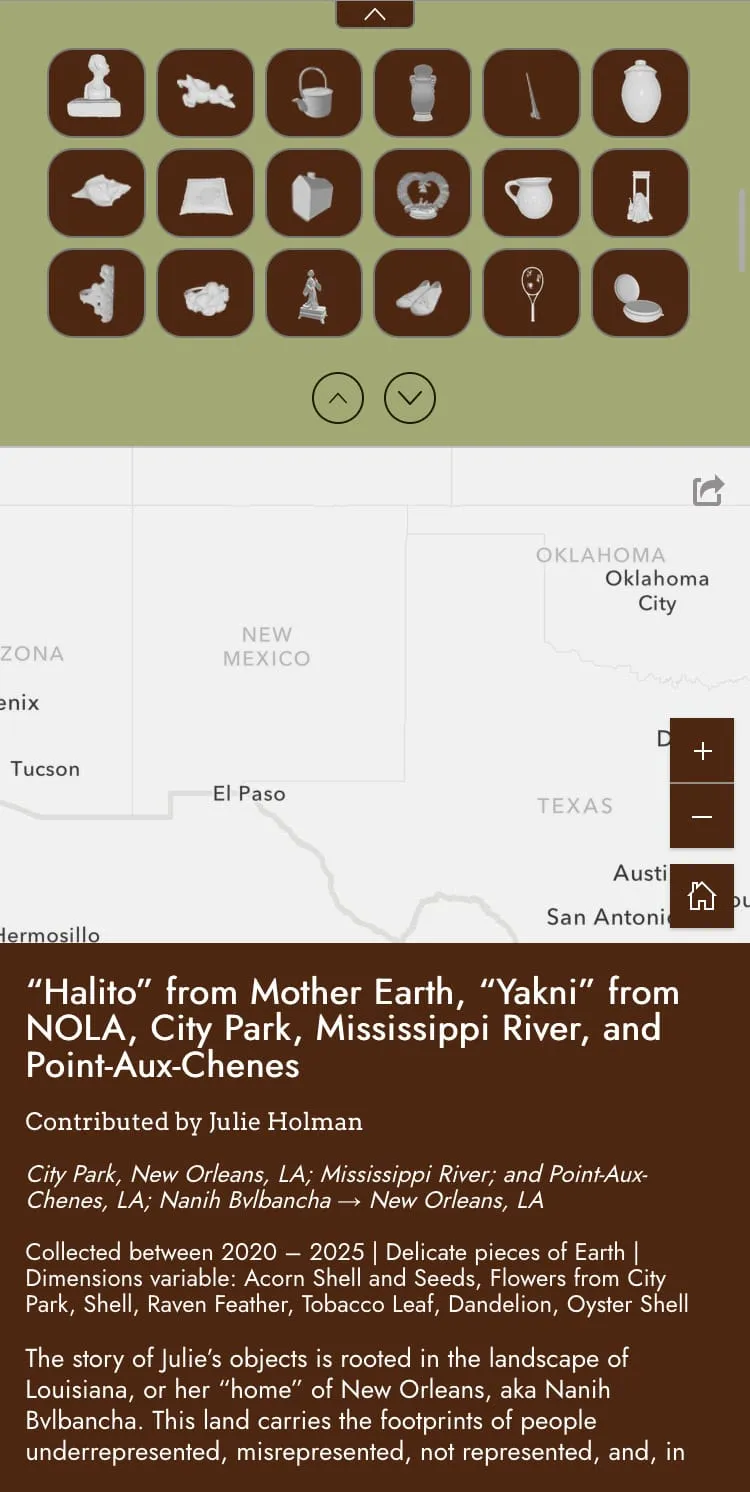
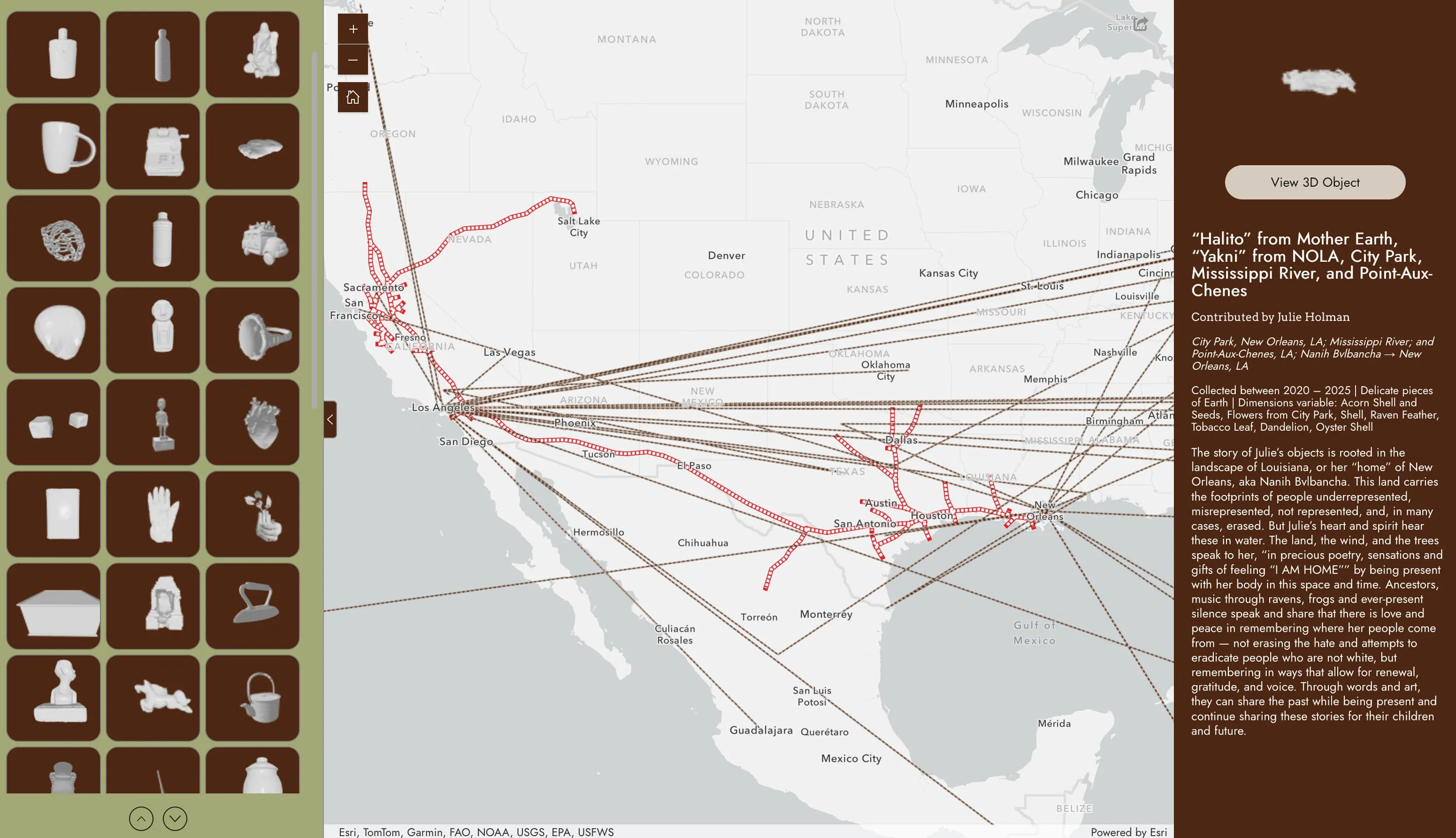
An open call asked the public to contribute objects connected to their idea of home. Over 50 community members from the eastern and western reaches of the country, from Los Angeles to New Orleans to Virginia, contributed their objects across a series of 3D-scanning and storytelling workshops. Together, they contended with layered tensions and complicated histories of migration as they shared the personal stories of their chosen objects.
After a technician scanned and modeled the objects, Rogers selected 30 to create molds from scaled-up 3D-printed models to reproduce them in tabby (a historic material made of oyster shells) over a series of casting workshops. The replicas will be laid within the sculptural installation at LA State Historic Park. This interactive arcGIS map collects the digitized versions of all the contributions, organized by their points of origin and destinations. You can click on each icon to view the object’s 3D scan and read more about its story. Through this practice of memory-keeping and collective archiving, the community works to answer the project's anchoring question: On the crossing between departure and arrival, what do we carry with us, and what gets left behind?
score for performance
Partitura para la interpretación
表演乐谱
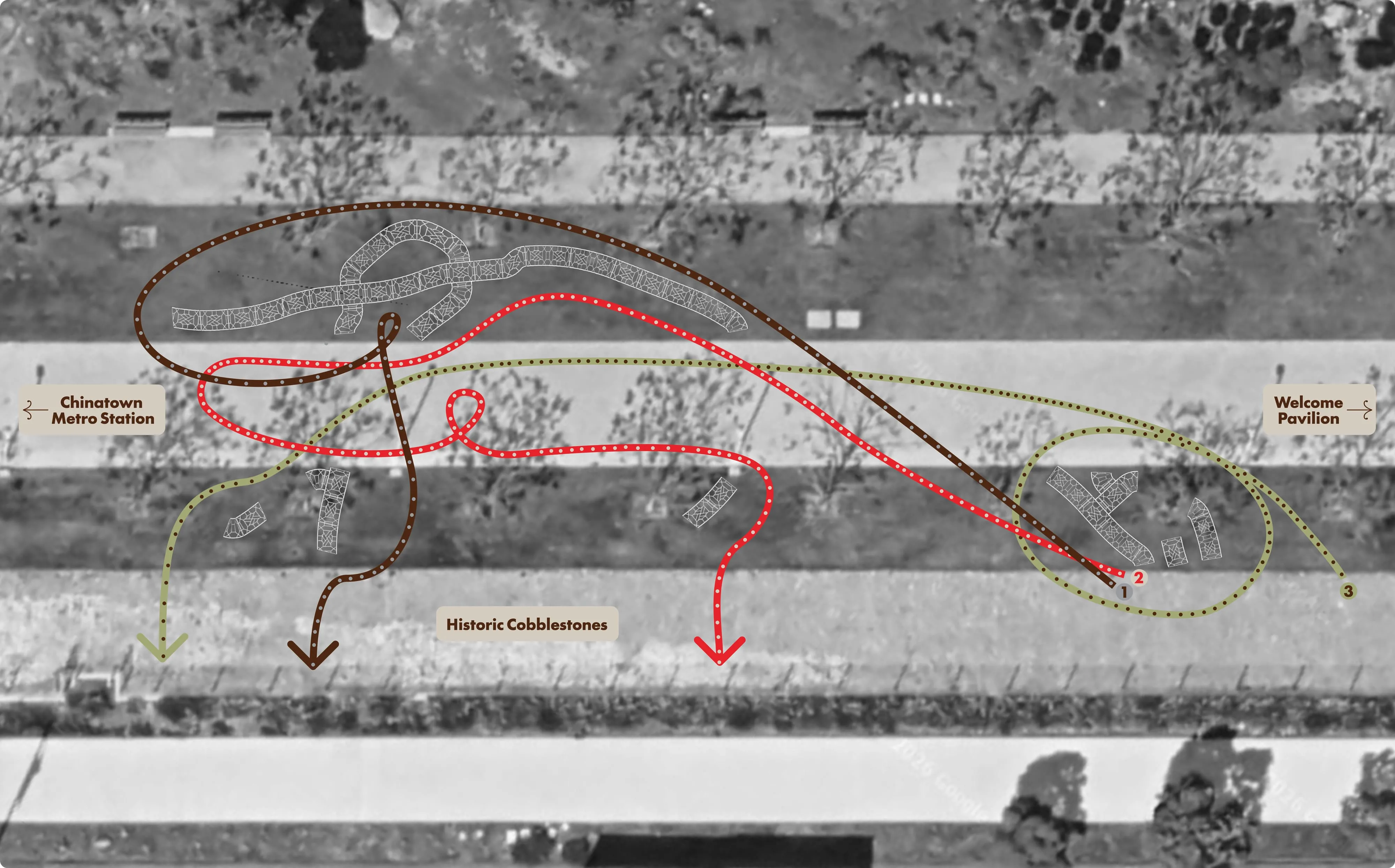
Score for Performance
traversing the land(scape)
Choose a path and begin walking. Change paths when you encounter someone, or continue until the end.
- Find an object that connects you to home(place). What has it witnessed or carried? Create its sound. Maybe it’s a hummed tune, a song lyric, a chirp, or something else.
- Carry your sound as you walk. When you hear another sound, respond to the new sound or make space for it to linger. Ask: What are we cultivating together?
- Transform. Notice where beauty emerges, and let what you see, think, and voice come into focus. Let the revelation of your encounter change your sound. Add without erasing. Continue to merge these sounds until another frequency becomes possible.
All paths meet at the historic cobblestones. Release this transformed sound aloud into the atmosphere.
This score was developed through a collaboration between LaRissa Rogers and Michelle Sui.
Partitura para la interpretación
Recorriendo el paisaje
Elija un camino y comience a caminar. Cambie de camino cuando se encuentre con alguien, o continúe hasta el final.
- Encuentre un objeto que lo conecte con su hogar (lugar). ¿Qué ha presenciado o transportado? Cree su sonido. Tal vez sea una melodía tarareada, la letra de una canción, un gorjeo o algo más.
- Lleve consigo su sonido mientras camina. Cuando escuche otro sonido, responda a él o déjele espacio para que perdure. Pregunte: ¿Qué estamos cultivando juntos?
- Transforme. Observe dónde surge la belleza y permita que lo que ve, piensa y expresa cobre protagonismo. Deje que la revelación de su encuentro cambie su sonido. Agregue sin borrar. Continúe fusionando estos sonidos hasta que surja otra frecuencia.
Todos los caminos se cruzan en los históricos adoquines. Libere este sonido transformado en voz alta hacia la atmósfera.
Esta partitura fue elaborada gracias a la colaboración entre LaRissa Rogers y Michelle Sui.
表演乐谱
穿越大地(与景观
选择一条路径并开始行走。若途中偶遇他人,可变换路径,亦可继续前行直至终点
- 寻找一件能将你与“家”(或某处)联系起来的物品。它曾见证或承载过什么?为它创造一种声音——或许是一段哼唱的旋律、一句歌词、一声鸣叫,或其他任何声响。
- 带着这声音继续行走。当你听到另一种声音时,既可以与之呼应,也可以留出空间让它回荡。试问:我们正共同培育着什么?
- 转化。留意美在何处浮现,让你的所见、所思与所发出的声音变得清晰聚焦。让这次相遇带来的启示改变你的声音——在不抹去原有声音的基础上进行叠加。继续融合这些声音,直至一种新的频率得以显现。
所有路径最终汇聚于那片历史悠久的鹅卵石路面。将这转化后的声音大声释放到空气中。
本表演乐谱之发展乃由 LaRissa Rogers 与 Michelle Sui 合作而成。
Musical composition and performance direction by Sharon Chohi Kim.
Resource Hub
Artist Reflection
Read LaRissa Rogers’s reflections on the origins and conceptual groundings of subterranean convergence in the artist’s own voice.
Artist ReflectionExhibition Guide
This guide contains the project description, information on related public programs while the installation is on view, and a deep dive into the context and process of creating subterranean convergence. The PDF is available in English, Spanish, and Chinese.
Exhibition GuideGuía de la exposición展會指南Activity Guide
Explore subterranean convergence with this family-friendly activity guide. Inside, you’ll find information and activities that invite audience members of all ages to listen, imagine, wonder, and deepen their connection to the artwork. The activity guide is available in English, Spanish, and Chinese.
Activity GuideGuía de actividades活动指南Storytelling Curriculum
This curriculum was co-developed by LaRissa Rogers and Angel Adams Parham. Circulated during a series of 3D-scanning and storytelling workshops as part of the project’s open call, these questions are meant to guide participants in sharing stories about the meaning of the objects they chose to contribute and their connection to their family history. This process centers storytelling as a form of memory-keeping and collective knowledge production.
Storytelling CurriculumTraversing the Threshold: Birthing a New Sound: Performance Score
Originally developed for the Democracy Now! zine, Traversing the Threshold: Birthing a New Sound extends subterranean convergence beyond the sculpture. Rooted in the jazz histories of nearby Bronzeville and Central Avenue, the score invites participants to carry memories of home into an ensemble shaped by listening, improvisation, and play. Through the vulnerability of encounter, it asks what we must relinquish to see differently, and how that shift in perspective might transform our relationships, our understanding of liberation, and the democracy we cultivate.
Traversing the Threshold